Home›Conditions›Sports injury
Sports injury care in Dumont
The strains, tweaks, and overuse that come with an active life. Care in Dumont built around getting you back to the sport rather than away from it.

Most sports injuries are the sudden strain or the slow overuse of a joint, a muscle, or the spine. Chiropractic care works on that mechanical side: restoring movement to what has stiffened, easing the tissue that is guarding, and rebuilding the strength and range you need to get back to the sport rather than sit it out.
Active people share a particular problem: the injury is not the worst part, the sitting still is. Here is a plain-language look at how sports injuries happen, how chiropractic care can help, and how to tell the tweak you can work with from the injury that needs a harder stop.
What causes sports injuries?
Sports injuries come in the same two shapes as most others: the acute one, where a joint or muscle is strained in a single moment, and the overuse one, where the same load applied again and again wears a tissue down past what it can recover from overnight. Both are mostly mechanical, and both respond to care aimed at how the body moves and loads.
The usual contributors we see in Dumont:
- Ramping up training load faster than the body adapts to it.
- A weak link up the chain, where a stiff hip or mid-back overloads a knee or shoulder.
- Skipping the warm-up, or training tired on an old niggle.
- Repetitive one-sided sport, from tennis to golf, that loads the same tissue for years.
- Coming back to full load too soon after the last injury.
Some sports injuries need a medical work-up first. A joint that gave way or locked, rapid swelling after an impact, an inability to bear weight, or a suspected fracture needs to be seen medically rather than booked with us. Part of a good first visit is telling you which kind you have, and whether it is safe to keep training around.
How does chiropractic care help with a sports injury?
Chiropractic care works on the mechanics of what went wrong and what set it up. Gentle, specific adjustments restore movement to the joints that have stiffened and guarded, and hands-on work releases the tissue that is bracing. Alongside that, you get the movement and loading guidance that rebuilds the injured part and addresses the weak link that let it happen.
In practice, a course of care usually blends a few things:
- Adjustments to restore motion where the chain has stiffened, matched in force to your body.
- Soft-tissue work through the injured tissue and the muscles compensating around it.
- Progressive movement to rebuild strength and range and get you back to full load safely.
- Practical changes to training, so the overload or the weak link does not set the injury off again.
The goal is not to keep you out of your sport. It is to settle this injury and return you to full load with the weak link addressed, so it does not become a yearly event.
What does care cost, and do you take insurance?
No referral is needed to book, and we will go over the costs with you up front so there are no surprises. Costs depend on your plan and what the injury needs, and we will always walk you through it in plain numbers first.
- No referral needed to book a first visit.
- We go over the costs with you before anything begins, so you know what to expect.
- Clear, up-front pricing if you are paying out of pocket.
We cannot promise a specific outcome or what your insurance will cover; every plan and every injury is different. What we can promise is an honest look, a straight answer, and a realistic view of when you can get back to it.
Over 4 million a year emergency-department visits in the U.S. come from injuries sustained in sport and recreation, according to research reported through the U.S. National Library of Medicine. Getting hurt is part of an active life; how quickly and how completely you come back is the part worth being deliberate about.
Source: Peer-reviewed study of emergency-department visits from sport and recreation, via the U.S. National Library of Medicine (PubMed Central). Figures are from 1997-2009 data. pmc.ncbi.nlm.nih.gov
Chiropractic care for Sports injury in Dumont
Chiropractic Care
Spinal Decompression
Shockwave Therapy
Sports injury FAQ: Dumont
For most people with common, mechanical sports injuries, gentle chiropractic care has a strong safety record. An acute injury gets a lighter hand, so the first visit is a careful history and check, and low-force options are used while it settles. If your history or exam points to a fracture or something that should be seen medically first, we will tell you.
Often yes, in a modified way, and that is usually better than a total stop. Part of the first visit is working out what load is safe to keep and what to back off, so you keep your fitness without feeding the injury. Where a full rest is genuinely needed, we will say so plainly rather than let you train through something that needs to stop.
Because injuries often trace to a weak link up the chain. A stiff hip or mid-back can overload a knee or a shoulder, so the injured spot is where it broke, not always where it started. Addressing that link is how we lower the odds of the same injury coming back once you return to full load.
It depends on the injury and how much your sport asks of it, and it is honest to say that coming back to full load too early is the most common way a sports injury returns. After your first visit we will give you a realistic window and a graded way back, rather than a date pulled from the air.
Back off the load that provokes it and keep gently moving what is comfortable, rather than either pushing through or shutting down completely. Ice and elevation help many acute strains in the first day or two. If the joint gave way, locked, swelled fast after an impact, or cannot bear weight, get it looked at medically before booking with us.
Back to it, without rushing it.
Or call us directly: (201) 387-7463
You might also look at
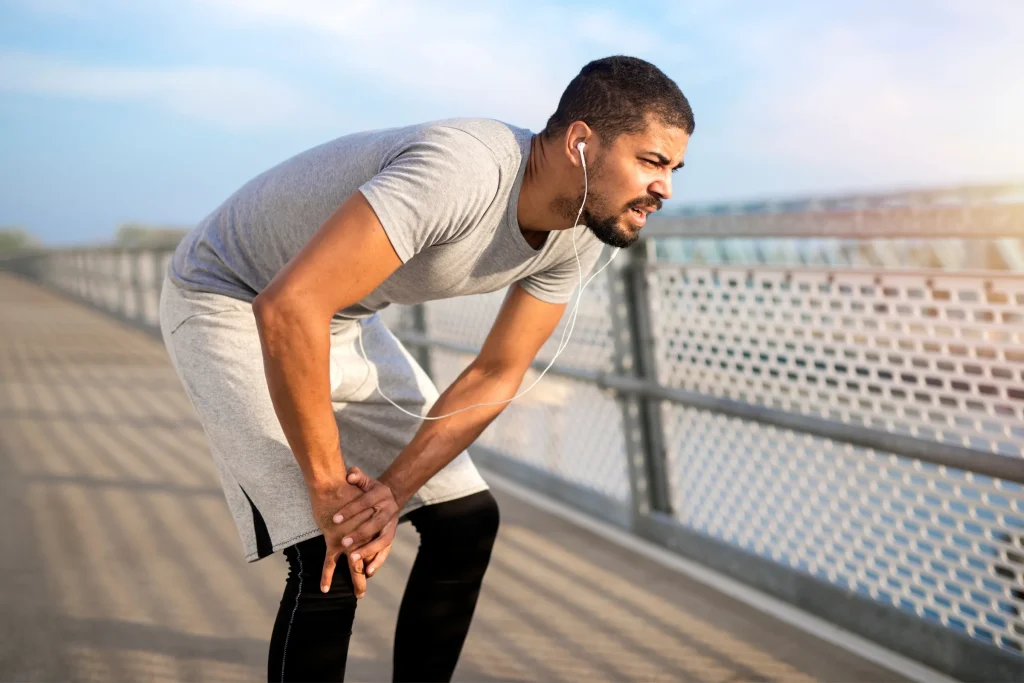
Knee pain
The joint that training loads tend to complain about first.

Shoulder pain
The overhead and one-sided sports that wear a shoulder.

Back pain
The core and spine that most sports lean on hard.