
Home›Conditions›Auto injury
Auto injury care in Dumont
Assessment and hands-on chiropractic care in Dumont after a collision, with careful notes from the first visit, and an honest answer about whether what you are feeling needs us, someone else, or just time.
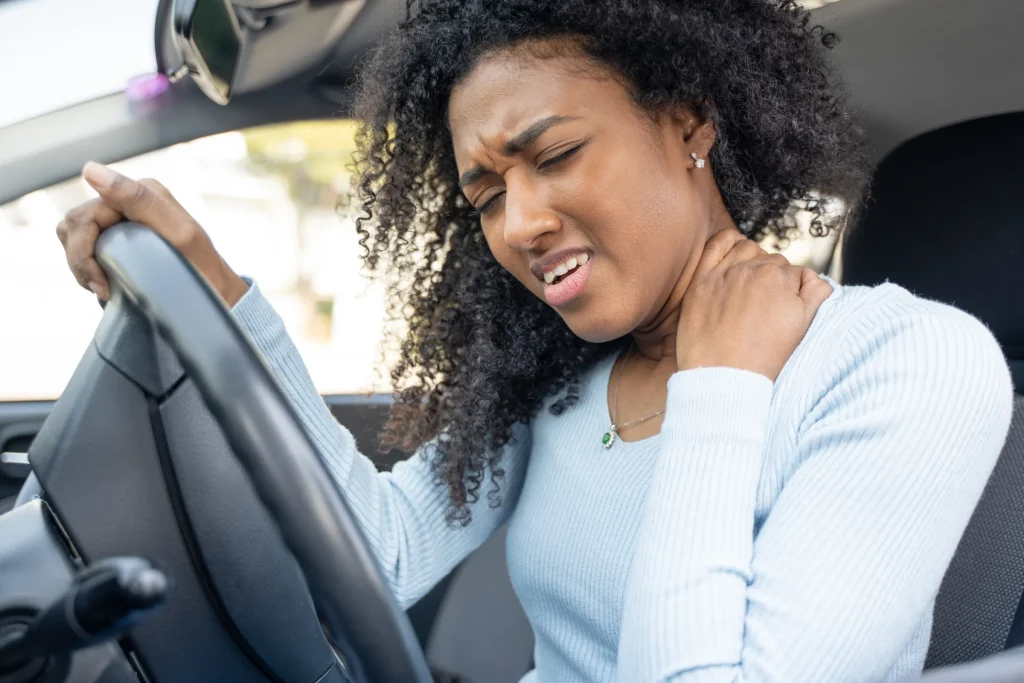
A collision loads your body faster than you can brace for, and the damage is usually to soft tissue rather than to bone, which is exactly why an X-ray at the emergency room can be clear while you still hurt. Symptoms often arrive a day or three later, once the adrenaline has gone and the tissue has stiffened. Getting assessed early gives you two things: a plan while the problem is still fresh, and a written record from the first visit if an insurer later asks.
Most people recover well after a crash. A meaningful minority do not, and the difference is rarely obvious in the first week. Here is what actually happens to the body in a collision, what is worth watching for, and where the line is between us and the emergency room.
Why you can feel fine and still be hurt
In a collision your head and torso are thrown and stopped again in well under a second. Muscles and ligaments take that load, and they do it while you are braced against a wheel or a seatbelt. Adrenaline is a very effective painkiller for a few hours, and soft-tissue irritation builds over the following day or two, so the gap between the crash and the pain is normal rather than suspicious.
It also means the severity of the pain and the severity of the crash are only loosely related. Low-speed collisions with barely a mark on the bumper produce real injuries often enough that we would rather look than have you wonder. If you feel foolish booking after a small bump, that is the reason not to.
- Neck pain and stiffness, often worst on the second or third day.
- Headaches that start at the base of the skull.
- Mid-back and low-back ache from the seatbelt and from bracing.
- Shoulder, wrist, or knee pain from the wheel, the belt, or the dashboard.
- Dizziness, poor sleep, or trouble concentrating in the days afterwards.
That last group matters. Dizziness, memory or concentration trouble, numbness, weakness, or pain that is severe and unrelenting are reasons to be seen medically first, not by us. We will say so plainly rather than start care.
What we actually do about it
The first visit is mostly examination and conversation: what happened, how you were sitting, where it hurts now, and how the area moves today. From that we work out whether this is mechanical and whether we are the right people for it.
If it is, care is gentle at the start, because an irritated, guarded area does not want a firm adjustment in week one. Force is matched to what the tissue will tolerate, and it changes as the area settles.
- Low-force work early, building as the area calms and tolerates more.
- Soft-tissue work for the muscle that has guarded around the injury.
- Movement you can do at home, which is what stops a stiff neck setting that way.
- Notes from the first visit onward, in case an insurer or attorney asks for them later.
We do not run a fixed number of visits because a claim allows it. You get a realistic range after the examination and an honest read as we go, including the version where you are better and can stop.
The paperwork side, briefly
Auto injuries come with an administrative tail that other problems do not. We document from the first visit, keep the record specific about what was found and what changed, and can send notes where they need to go. What we will not do is inflate a record or extend care to suit a claim. The notes say what happened, which is what makes them worth anything.
- No referral needed to book a first visit.
- We go over the costs with you before anything begins, so you know what to expect.
- Clear, up-front pricing if you are paying out of pocket.
Coverage after a collision depends on your policy, the other driver's, and your state, and it is genuinely confusing. We will tell you what we can see and what we cannot. We cannot promise a specific outcome or what any insurer will pay. What we can promise is a careful examination, an honest read, and a straight answer if this is not ours to handle.
25 to 40% of people still have symptoms a year after a whiplash injury, according to a peer-reviewed review of the whiplash literature, which notes that recovery rates across studies vary widely. Most people do recover. The reason to be assessed early is that you cannot tell in week one which group you are in.
Source: Peer-reviewed review of whiplash diagnosis, treatment and associated injuries, via the U.S. National Library of Medicine (PubMed Central). pmc.ncbi.nlm.nih.gov
Chiropractic care for Auto injury in Dumont
Chiropractic Care
Spinal Decompression
Shockwave Therapy
Auto injury FAQ: Dumont
It is worth it, because soft-tissue symptoms commonly arrive a day or two later and low-speed collisions produce real injuries often enough to be worth ruling out. A short examination either finds something while it is fresh or tells you that you are fine, and both of those are useful answers.
An X-ray is very good at showing bone and cannot show much about muscle and ligament, which is where most collision injuries actually are. A clear image rules out the most serious problems, which matters, but it does not mean nothing was injured.
As soon as you are up to it, and sooner is generally better for both the care and the record. If you have any red-flag symptoms, including severe or unrelenting pain, numbness, weakness, confusion or dizziness, be seen medically first and come to us afterwards.
We document carefully from the first visit and can send notes where they are needed, and we will be straight with you about what your coverage does and does not appear to include. We will not stretch a course of care to fit a claim.
It depends on what was injured and how long it has been going on, so anyone offering a number before examining you is guessing. We give you a realistic range after the first visit and revise it honestly as we see how you respond.
Get it looked at while it is fresh.
Or call us directly: (201) 387-7463
You might also look at

Whiplash
The specific neck injury behind most collision pain.

Neck pain
The stiffness and guarding that often follow.

Headaches
The pattern that starts at the base of the skull afterwards.